Introduction
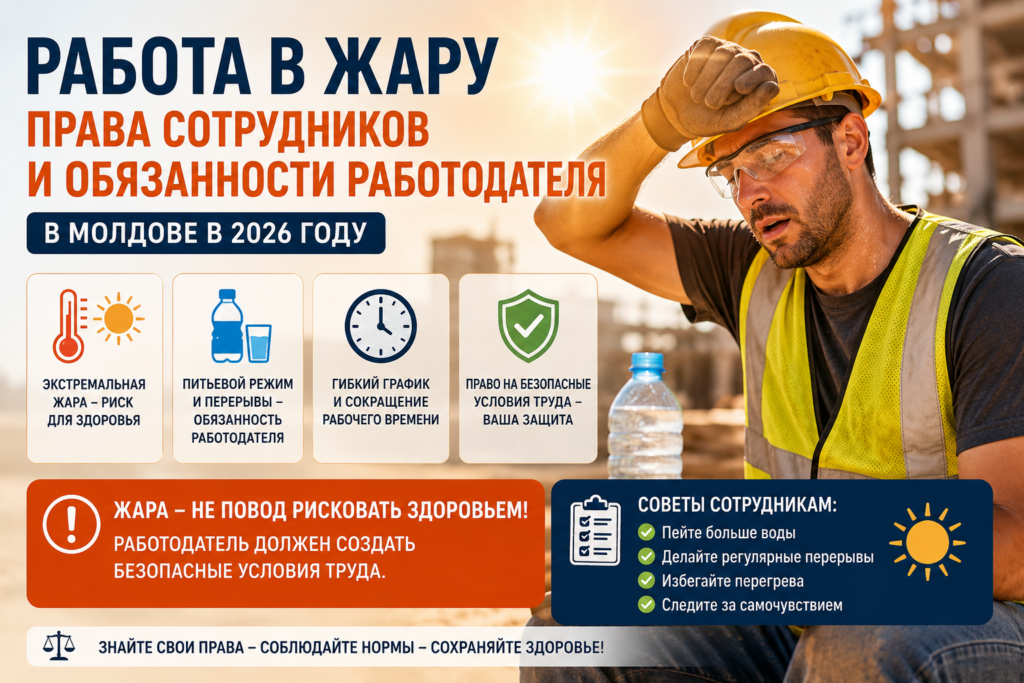
Summers in Moldova are becoming hotter, and periods of extreme temperatures are becoming more frequent. This directly affects working conditions, especially for employees who work outdoors, in production facilities, and in offices without air conditioning. In 2026, the issue of working during heatwaves is no longer just a matter of comfort, but one of health, safety, and compliance with the law.
In this article, we will look at:
- what rights employees have at high temperatures;
- what the employer is required to provide;
- at what temperature work can be interrupted;
- what compensation is provided;
- practical recommendations for companies and employees.
What Is Considered Extreme Heat
In Moldova, there is no clearly established “critical temperature” for stopping work, but sanitary standards and recommendations from occupational safety services serve as a reference.
As a rule, the following are considered dangerous conditions:
- above +28°C — increased strain on the body;
- above +30–33°C — risk of heatstroke;
- above +35°C — potentially hazardous working conditions.
This especially affects:
- construction workers;
- agricultural workers;
- couriers;
- employees in warehouses and production facilities.
Moldovan Legislation: What the Law Says
Working during heatwaves is regulated by occupational safety rules and sanitary regulations.
The employer is obliged to:
- ensure safe working conditions;
- minimize health risks;
- adjust the work schedule if necessary.
If working conditions endanger health, the employee has the right to:
- refuse to perform the work;
- request improved conditions;
- contact the labor inspectorate.
Employer Obligations During Heatwaves
1. Providing Drinking Water
The employer is required to provide access to clean drinking water in sufficient quantity.
2. Breaks During Work
At high temperatures, additional breaks must be introduced:
- every 1–2 hours;
- in a cool area or in the shade.
3. Changing the Work Schedule
It is recommended to:
- start work earlier (for example, from 6:00–7:00);
- avoid work during peak heat hours (12:00–16:00).
4. Protective Equipment
Employees must be provided with:
- head coverings;
- lightweight clothing;
- protection from the sun.
5. Cooling the Premises
For offices:
- air conditioners;
- ventilation;
- blinds or sun protection.
Employee Rights
The employee has the right to:
- refuse work if there is a risk to health;
- demand safe working conditions;
- receive additional breaks;
- contact supervisory authorities;
- not be held responsible for work stoppage caused by the employer.
Can You Not Work During a Heatwave
Yes, in certain cases.
If:
- the temperature is critically high;
- protective conditions are absent;
- there is a health risk;
the employee may:
- suspend work;
- inform management;
- document the violation.
Important: the refusal must be justified and linked to a real danger.
Employer Liability
If the employer ignores the rules:
- fines may be imposed;
- labor inspectorate inspections may take place;
- lawsuits may be filed;
- compensation may be awarded to employees.
Practical Tips for Employers
To avoid problems:
- introduce a summer work schedule;
- provide water and shade;
- monitor the temperature;
- organize training sessions;
- automate control of working conditions.
Practical Tips for Employees
- drink water regularly;
- avoid direct sun exposure;
- wear lightweight clothing;
- take breaks;
- monitor your health condition.
How Heat Affects Productivity
Studies show that:
- at +30°C productivity drops by 10–20%;
- the number of mistakes increases;
- the risk of injuries rises.
Investing in comfort = increasing efficiency.
Common Employer Mistakes
- ignoring the temperature;
- lack of water;
- lack of breaks;
- forcing employees to work in dangerous conditions;
- lack of instructions.
FAQ (Frequently Asked Questions)
At what temperature can you not work in Moldova?
There is no direct ban, but above +33–35°C, working without protection is considered dangerous.
Is the employer required to shorten the workday?
Not always, but the employer must adapt the conditions and schedule.
Can you leave work because of the heat?
Yes, if there is a health risk and safe conditions are absent.
Must work stoppage due to heat be paid?
If the stoppage is caused by the employer — yes.
Where can a complaint be filed?
At the State Labor Inspectorate.
Conclusion
Working during heatwaves is a serious risk factor that cannot be ignored. In 2026, companies that care about their employees gain not only staff loyalty but also higher productivity.
Compliance with the rules is not only a legal obligation, but also an investment in a sustainable business.
SEO Keywords
working during heatwaves Moldova 2026
employee rights heatwave
working conditions high temperature
employer obligations in summer
heatwave and labor law Moldova
breaks during heat at work